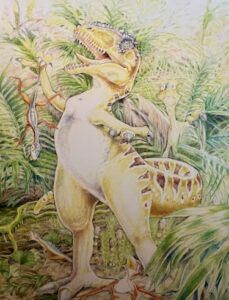
 I was watching a compelling documentary the other day in which a baby T. rex (t.) is lagging behind his siblings and very large father (T.) while swimming across a lake. There is a big chompy Mososaur lurking beneath, and as lifelong consumers of television, we all know from the urgency of the violins that it isn’t going to go well for little t. And it doesn’t. This is merely one scene from Prehistoric Planet, a wonderful Apple TV series about dinosaurs and all the spectacular ways they can die without an asteroid.
This dead baby T. rex scene and all the others in the show are not fictional. And we know this because David Attenborough is narrating and David Attenborough would not lie to us.
All right, some of it might be speculation.
The thing is, we know a heckuva lot more about dinosaurs than we used to. Our knowledge base does not always stay put, because science is not religion. For instance, a fellow named Thomas Henry Huxley made the case that birds evolved from theropod dinosaurs way back in 1861, but the idea didn’t take. At the time, evolution was considered in many quarters an affront to God, who is seldom credited with having an imagination.
Besides that, later scientists pointed out that birds and dinosaurs couldn’t be related because birds need fused clavicles (wishbones) and dinosaurs didn’t have any clavicles, fused or otherwise. The clavicle bone of the tyrannosaurus was only the size of a canoe paddle and had been overlooked. Someone reported he had found dinosaur clavicles in 1936 but nobody listened to him because it was understood that they didn’t exist, and it was another fifty years before the presence of wishbones in theropod dinosaurs was generally acknowledged. By the early 1970s, pretty much everyone was going on and on about birds being modern dinosaurs, exactly as Huxley had proposed a hundred years earlier.
The idea that continents drifted was first proposed in 1596 and was still considered ridiculous when I was in fifth grade, when we kids pointed out the parallel shapes of Europe/Africa and the Americas, and were promptly chuckled at and gently corrected. And all the theropod dinosaurs we knew about were depicted upright and sitting on their massive tails like they were stadium stools.
I’m that old. Honeys, I’m a year older than Godzilla.
But now we have Prehistoric Planet. “Prehistoric” refers to the time before stuff got written down, so pretty much everything from 4.5 billion years ago until five thousand years ago. Your nimbler dinosaurs may very well have been taking notes on things, and a bunch of them have places on their heads to tuck a pencil, but if any of their efforts survived the asteroid we can’t recognize it, and won’t until we discover the Rosetta Meteorite.
We’ve come an insanely long way from the times we figured dinosaurs were dropping eggs like afterthoughts and roaring off to stomp something or shovel in foliage. Much has been learned about their anatomies and heritage and much can be inferred from the behaviors of their living descendants. This stuff is probably close to real.
There is the matter of the carnotaurus though. Like many theropods, he had itty bitty arms, but his were diminutive even by the low armage standards of the time. They were basically nubbins submerged in their chest flesh, had no claws, yet were massively muscled at the shoulder joint, with good rotation. Well. What on earth for? The creators of the show speculated they might be used in a courtship display.
So there he is, our hopeful boy Carnotaurus, standing proud in front of the female, when—poink! Out pop his bright blue arm noodles, and commence twirling like tassels on pasties.
Evidence thin? Maybe.
But I would totally do that bad boy.

The clip of the Carnotaurus pair was amusing. I especially like the eyes — the look of dejection in them at the end was priceless.
Pretty sure it’s all real, too.
I didn’t find the bright blue arm noodle reconstruction to be particularly preposterous. There are lizards that have dewlaps under their throats which are invisible until deployed, but then are brightly colored flags.
I liked the idea of the undersides of the arms being brightly colored and hidden in the normal rest position. There are a bunch of frogs with bright yellow patches on their legs that aren’t visible until the frog jumps or waves its legs around as some species do while displaying.
On a side note, I was out doing field work one day and found a female and a male fence lizard sitting on a wall about a foot apart. Females are larger and have a bark pattern on their backs. The males have a rusty tinge to their upper sides and bright blue patches on their flanks. They’re probably actually black, but highly reflective.
The male was doing pushups to display his blue patches while the female watched.
I caught both of them and showed them to my field assistants, demonstrating that they’ll go completely rigid if placed on their backs.
After that I put them back on the wall where I thought they’d been before. As soon as the female recovered from her torpor she ran over to the male and bit the shit out of him until he ran six inches away, presumably to his original territory. Whereupon the female marched back to her place on the wall.
I’d always assumed that I’d put them back in the wrong spots. But it occurred to me recently that maybe the female was punishing the male for getting her caught in the first place.
Paleontologists have some standard go to phrases and when a large animal has comically tiny arms, the box next to “display structure” often gets checked.
Carnotaurus was discovered by an Argentinian paleontologist named Jose’ Bonaparte, nicknamed Sr. Bone-A-Part for his excavation and preparation techniques. As far as I know only one skeleton has ever been found and I’m not aware of any additional studies being made after Bonaparte wrote his monograph.
The arm is reconstructed as being composed of progressively smaller elements with rather undeveloped joints which probably means it was a pretty stiff unit. That is assuming the fossil material was reasonably complete and properly evaluated.
Could Carnosaurus rotate its arms and use them for display? Sure, it’s possible. If we only had flattened fossils of peacock spiders we’d have no idea they use their abdomens like flags.
There is a propensity in paleontology to assume that structures, no matter how small must have had a a function. However if we look at modern examples, there are plenty of cases of animals with substandard issue parts that don’t do anything with them.
Take for example the emu, the second largest living ratite bird. It has very nice forelimbs with typical formation of the bones from the humerus right down to two little claws. The joints aren’t as well developed as those in a flying bird, but they’re better developed than those of Carnotaurus. The entire forelimb isn’t much bigger than one of my hands, which are admittedly large, but still not all that big for a 69 pound bird. I’m not aware that emus do anything with their forelimbs. Their body feathers are so shaggy that the forelimbs really aren’t all that visible.
Paleontology may as well be called the science of wild speculation. It was once made up of geologists with little or no knowledge of anatomy, biological function and modern animal behavior. It’s a bit better balanced now, but we still see nonsense based on very little evidence. There’s a recently named sauropod that is mostly known from its hips and hind leg bones which was described as being a powerful kicker and reconstructed as defending itself by kicking predators. This is an animal built like an elephant. Elephants don’t do anything more gymnastic than maybe rearing slightly to reach high branches.
Most of you have probably never heard of alvarezasaurids. There’s a good reason. They’re mostly small and represented by fragmentary material. There are several nicely preserved skulls with long tubular snouts fitted with tiny nubs of teeth. Sorta like an anteater. There are also nicely preserved forelimbs characterized by one massive claw and short heavily built arm bones. Did I mention they had short arms? They’re mostly all claw with just enough bones to wiggle that claw. A lot like an anteater. But the hind limb is very long and slender, very much like those a fleet runner. Not at all like an anteater.
Most reconstructions show this animal on its belly, scrabbling at termite mounds with its tiny forelimbs, its anteater head at the end of its long neck far above where presumably the termites are being unearthed.
I could go on at length (which you’ve been doing so far, Bruce), but I’ll leave on a note about the furculae of T. rex. They’re not the size of a canoe paddle, unless it was for a miniature canoe. Not much longer than my forearm.
You’re going to have to roll with my hyperbole, Bruce, because it ain’t ending anytime soon! Also, we never got into his “pretty stiff unit,” but that would be fun.
Aw, Murr… as I’ve said, things are always funnier if you have a dirty mind!
Yeah, I don’t know how they can extrapolate on how they look, how they act, just on the basis of the bones we have found. If birds are descendants of dinosaurs, and bird are usually colorful, why do they depict dinosaurs as being dun colored? I’ve read that chickens are the closest living descendant of the T. Rex. Chickens come in an array of colors. I live close to a farm market, and they have chickens. Sure, there are the brownish ones, the white ones. But also the “Easter Eggers”, which are bluish and lay bluish eggs. There are the Mille Fleur, which are small and have poofy feathers around their feet. They are SO adorable! I think that, David Attenborough notwithstanding, this should all be taken with a grain of salt. I would be interested to hear what creatures who view our fossils after the asteroid/nuclear bomb/epidemic finally strikes us out, have to say about us. Of course, I won’t. I’ll be long gone. And good riddance.
There’s a LOT you can learn from the bones. Ask Bruce. And most of the dinosaurs depicted in this show are very colorful. That old dun-colored dinosaur is from my childhood. I believe some fossils with skin/scales have been found in which the actual pigments can be determined, even. And us? We will be found associaited with a nice thick stratum of plastic.
Yes, there are several species of feathered dinosaurs and early birds in which the chemicals preserved in the impressions around their bones have been analyzed and used to determine colors and patterns. So we know for instance that Archaeopteryx had black feathers and Sinosauropteryx was brownish with pale bands on its tail.
There’s a nodosaur mummy, Borealopelta which is so well preserved that it’s been determined that it had a rusty upper part and paler underparts.
Since the discovery of feathered dinosaurs in 1996, paleontologists have been spending more time analyzing fossils for traces of skin and feathers. That’s revealed that many dinosaurs had feathers, but most of those are the carnivorous dinosaurs.
Carnotaurus’s skin is actually well known from impressions that originally covered the entire fossil. Bonaparte discovered a beautifully preserved dinosaur mummy which he then destroyed to extract the bones. He noted that the impressions of the skin had been present rather offhandedly. A later researcher returned to the excavation site and recovered the fragments.
Carnotaurus was covered with scales in a variety of shapes and sizes and so is one of the few dinosaurs whose surface appearance is completely known.
Wow- I’ve read this a few times and need to reread again………… impressive
In my time machine, I’ll definitely go back to see the giant dragonflies. I could visit the lair of a carnotaurus, if I came across it, but I’m not sure I could keep my hand over my mouth sufficiently to stifle my immature cackling at its stupid blue arms that look like weird tits.
Then again, had mammaries even evolved? I think they came later.
Well, MY mammaries evolved, but only after menopause, when they weren’t really needed. I was an A- cup until then. Then blossomed into a B. Where were you, fat cells, when it mattered?
Well, the giant dragonfly, Meganeura is about 175 million years before the earliest known dinosaurs appeared. And while it is a dragonfly relative, it is sufficiently different to not be considered a dragonfly, not even ancestral to them.
As far as mammaries go, the ancestors of mammals were present 359 million years ago. We don’t know when the first mammals developed mammaries or hair for that matter, but there were critters very similar to mammals present when the earliest dinosaurs appeared around 225 million years ago.
At one time it was thought that monotremes (platypus and echidna) were living fossils and could be thought of as what the earliest mammals would have been like in terms of having hair, laying eggs and producing milk from modified sweat glands. But it turns out that the earliest known monotremes, which were already very similar to platypuses appear in the fossil record about 160 million years ago by which time mammals were really mammals. The best guess is that monotremes evolved from a separate lineage of synapsids and marsupials and placentals evolved from another lineage and diverged from each other pretty early on.
There were mammals going back to the Triassic, so sure, there were …oh never mind, Bruce already weighed in on early titties. I need to keep up.
If early mammals were like platypuses, then early titties were just spongy patches of skin, not the bulbous structures that we try to hold near and dear.
Just like a real life romantic situation. What’s not to believe?
It do ring true, don’ it?
“Bright blue arm noodle” — now, there is a truly original phrase, never before seen in print. And such an image! Thanks, Murr!
I love words that have not been strung together before. I fact, I have been delighted by that for so long (from childhood) that my first novel is ABOUT that.
You might also enjoy the Apple TV The Secret Lives Of Animals. Great series of observations & a nice sense of humor looking into especially gifted species. Who knew there was a spider smaller than your thumbnail who sculpted portraits of himself? Or a bear that weaves his bedding? Or a frog that can compress his organs so much that he can turn invisible? Mind blowing stuff.
I’m in! Thanks Holly!
Around 1971 or so I took a very interesting course at U of Mich called “Evolution and Human Behavior.” One day the subject was male displays among non-human animals, and what is it that impresses a female. The prof said something about a female wanting a male with “good genes.” How, he asked, could a female tell if a male had good genes? I nudged my friend in the next seat, pointed to my Levi’s, and whispered “Double seams!”
Fitness appears to be what females look for in a male. Fitness can be defined as being healthy and it also can be defined as having outrageous display structures like antlers or extravagant feathers. Things that don’t enhance your survival chances, but if you manage to evade predators while bedecked with a mummers’ parade costume, then chances are you’re fit.
There was a study of whydah birds that explored mate selection and fitness. Male whydahs have several long tail plumes and they perform mating flights to impress the females.
The researchers proposed that the females selected the males with the longest feathers and by doing so they drove the evolution of ever longer feathers until they got so long that they became impediments to survival.
The researchers clipped the tail feathers of the most successful males and glued them onto the tails of the least successful with predictable results. Survival became less important than passing on the genes. It didn’t matter how stupidly outrageous the display structures were as long as the bearer of those structures lived long enough to pass on his genes. Of course the more offspring produced and the greater variety of the genes (ie mating with multiple partners) the more successful that individual was/is in the grand scheme of evolution.
“Runaway sexual selection” we called it.
Pretty much.
And I thought Whydah was just the name of a ship.
“if you manage to evade predators while bedecked with a mummers’ parade costume, then chances are you’re fit.”
I almost did a spit-take when reading this!
I heard on Wait Wait this past week that a lot of women are saying “who needs a man?” and are turning to AI for a “significant other.” The reason? They program the AI to ask about their day… and LISTEN. To ask them questions… and LISTEN. And to not “mansplain” what they are doing wrong and how to solve the problem, whatever it is. Also, since the women also program the appearance of the AI, it looks more like Luigi Mangione than John Fetterman. So AI and a vibrator is all they need.
I’m glad you enjoyed that.
I managed to squirt cranberry juice out my nostrils yesterday, but I don’t think it was from laughing. Sneezing while drinking probably. I once sneezed while eating breakfast in a restaurant. Spent several hours after that picking home fries, eggs and toast out of my sinuses.
Can AI give you that?
Stop that right now!
The blue things…didin’t do it for me.
didn’t
I’m all in for a man who makes me laugh and them nubbins made me laugh.