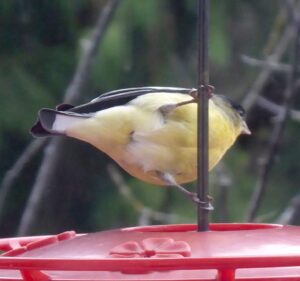
 It’s amazing to me how little people notice about the different birds, even though I was one of those clueless people not that many years ago. I was the one who’d never heard of a lesser goldfinch even though we’ve got more of them in the garden than anything else. Most people know how to navigate the digital world but don’t know much about the living world. Even my knowledgeable neighbor once remarked how happy she was to see the American goldfinches come back in the spring. Our goldfinches don’t come back. They never leave. She just didn’t recognize them in their snappy brown winter suits.
I didn’t even notice the obvious stuff. Like, at one point I was completely perplexed by being dive-bombed by crows. I suspected a nest was involved, but it seemed like a case of poor character judgment to me. I was not aware I was probably a few feet away from a big ol’ blue-eyed baby crow on the ground, during the two or three days it’s blundering around trying to figure out how to flap wings. Once it’s airworthy, Mom and Dad will leave me alone. It’s good to understand these things. Otherwise you might be tempted to haul off and smack a crow, and that’s an excellent way to be tormented by that crow and all her descendants for the rest of your natural days.
Education is the antidote to ennui. Because learning about the world sharpens up our noticers, and noticing limbers up the neurons so they can swat away boredom. That is why, thanks to recent research, I’m now looking forward to seeing my next earwig because I’ll know if it’s a girl or a boy. I learned how to tell them apart by their tail sproingers.
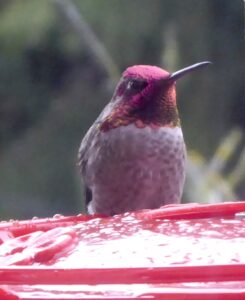 Most people don’t need to know much about hummingbirds to appreciate them. They’re compelling enough on their own. We have several species around here but by far the most common is special, even by hummer standards. Anna’s Hummingbird, like the goldfinch, doesn’t go anywhere for the winter. Little suckers either stay put or are replaced by others just like them; the crew is here all year, and the horny little bastards have a super-long breeding season.
So we hang a nectar feeder all winter, and have to make sure it isn’t frozen up by dawn. I have a surprise for them this year. I just planted a hummingbird plant that blooms in the winter, it says here on the label. It’s not a native. It’s a floral accent, and that accent is Australian. I’m hoping it will let me sleep in some icy morning.
The male Anna’s seduction routine is spectacular. They bullet up high in the sky, hover for a moment, and then bomb straight down at a billion miles per hour in front of a likely female and pull up just before a fatal planetary impact. The spreading of the tail feathers to pull out of the dive is so sharp it makes a chirp, and not just any minor chip-note but a distinctive eruption much like the one your smoke alarm makes in the middle of the night.
So every time I hear that mega-chirp, my head snaps straight up and there’s the little zipper up there in the sky, like a tittle on a page, getting ready to do it again. Over and over, every thirty seconds. I can’t think of a season they don’t do this, so it must be fun.
It was an ornithologist who got to the bottom of the chirp sound by removing some tail feathers from the bottom of the bird and seeing what happens. Sure enough, no chirp. Just a tiny splat. Ornithologists. I swear.
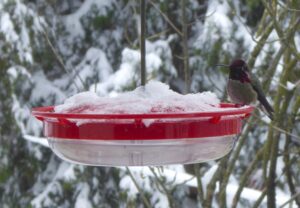 Anyway, I’ve been watching this display for years, and that’s how I managed to notice an individual. Any time your neurons get limber enough to pick an individual critter from the herd, you have vanquished boredom for good. You’re invested. This particular hummingbird has been doing the dive all afternoon but hasn’t eked out a chirp yet. I think he’s just a kid. You can tell he’s trying but he just can’t commit. He’s not starting high enough, for starters, and if you’re going to butt-chirp you have to get up some speed. Like, enough that if you didn’t pull up again you might burst into flame during re-entry. It’s got to be scary at first and that flight path needs to look like a “J.” This guy is more of a wide “U.” I can’t blame him. But he’s working on it, and before long he’ll be either impressing females right and left, or just annoying them to the point they give in so they can get some sleep. By that time I won’t be able to tell him from the other male hummingbirds, gorgeous assholes, every one.
But I’m not bored.
If there are nonbinary earwigs, don’t tell me.

People doing things to animals in the name of science can be incredibly cruel. I read an account from a nineteenth century observer about the uncanny ability snapping turtles had to find their way to water. He started by moving a snapper ever longer distances from water and trying to confuse it, but it unerringly found its way back to the pond. He finally chopped its head off, but even then the headless corpse moved in the direction of the pond.
A slightly less cruel experiment was made to determine what female whyddah birds found attractive in male whyddah birds. Whyddah birds are an African species where the males are endowed with long tail feathers. The hypothesis was that longer tails were more attractive to females. A very popular male with long tail feathers was bobbed and the clipped feathers glued onto a scrub with short tail feathers. Predictably the females’ devotion switched from the clipped male to the augmented male. It was noted that longer tail feathers didn’t enhance the survival of the endowed male, but his ability to carry on while burdened with extra long feathers encouraged females to seek out his genes.
The true test of evolutionary success isn’t survival of the fittest, but reproduction of the fittest. If you’re not passing on your genes, it doesn’t matter to the gene pool how long you survive.
The true test of a bird’s survival is the ability to avoid ornithologists.
Where I come from, we don’t see hummingbirds, but occasionally have visitations from Humming-bird Hawk-moths. It always takes several seconds for different parts of my brain to resolve the “It looks like a hummingbird, it acts like a hummingbird!” conundrum for the geographical reality of the situation. It’s even more amazing that you have hummingbirds around in Winter!
As for invasive scientific techniques, I think we all have different limits as to what is acceptable. I have naturalist colleagues who take specimens of invertebrates which can only be identified to species by dissection of genitalia. As a county recorder for Odonata (dragonflies and damselflies), I do not net flying adults, nor pond dip for larvae. That said, if an insect wants to land on me, that’s ok, and if my dragon whisper skills are working, there’s no buzz quite like coaxing a big hawker to step onto a finger (best done in cool temperatures so that the insect gets payback in the form of my body heat). I’ve never heard one fart, but the larvae can use their butts for jet propulsion.
There are hundreds of hummingbird species. It is truly astonishing. I got to see 40 or 50 of them when we visited Costa Rica. Dazzling.
I’ve seen the J-swooping flight of the ruby-throated hummingbird, the only species we see here in Maryland (that I know of). I’ve heard the butt chirp. I’ve felt the wind beneath their wings.
Some people live their whole lives and never see a bird’s nest or a hummingbird moth or anything beautiful.
I was refilling hummingbird feeders, heard the drone of wings, looked up and there was a hummingbird about an inch away from my eye. I wondered if it was perceiving me as an organism or just a big eye. Not a comfortable experience.
That’s the main purpose of eyeglasses. Hummingbird deflection.
Was out Xc skiing at teacup today. I observed a trio of woman standing at a trail intersection finishing their sandwiches standing on their skis. Before one of women could finish her last bite a bird swooped in from behind and snatched it from her hand. Bird 1, human 0. I think it was a scrub jay.
Close! I think it was a gray jay. Your sandwich is not remotely safe from them.